
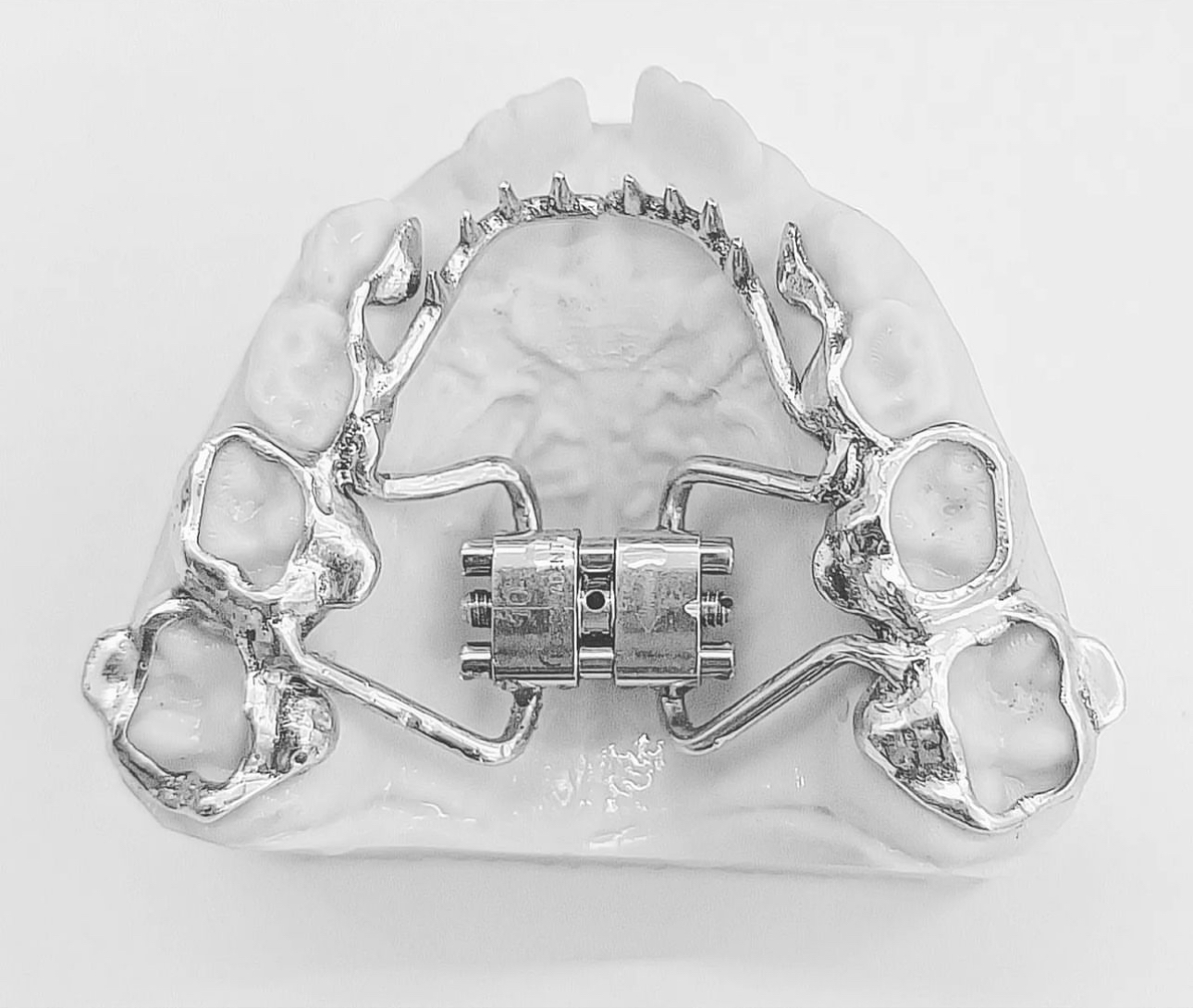
Palate Expanders & Maxillary Expansion
Guiding jaw growth to create space naturally, improve breathing, and avoid tooth extractions. Specialist palate expander treatments in Amersham and London.
Why Orthodontic Expansion Matters
A narrow upper jaw can restrict space for adult teeth, contribute to crossbites, and reduce the size of the nasal breathing space. By gently widening the palate at the right time in development, we can create space naturally, correct bites, and often improve nasal breathing - without extractions.
The type of palate expander we recommend depends on your age and bone maturity. We offer distinct approaches: Tooth-borne RME for younger children, Tooth and bone-borne MARPE for teenagers, and adult palatal expansion using MARPE, FME, and MSE for older patients. Our complete Adult Palatal Expansion UK pillar page covers costs, risks, recovery, and appliance comparisons in depth.
Tooth-borne RME (Rapid Maxillary Expansion)
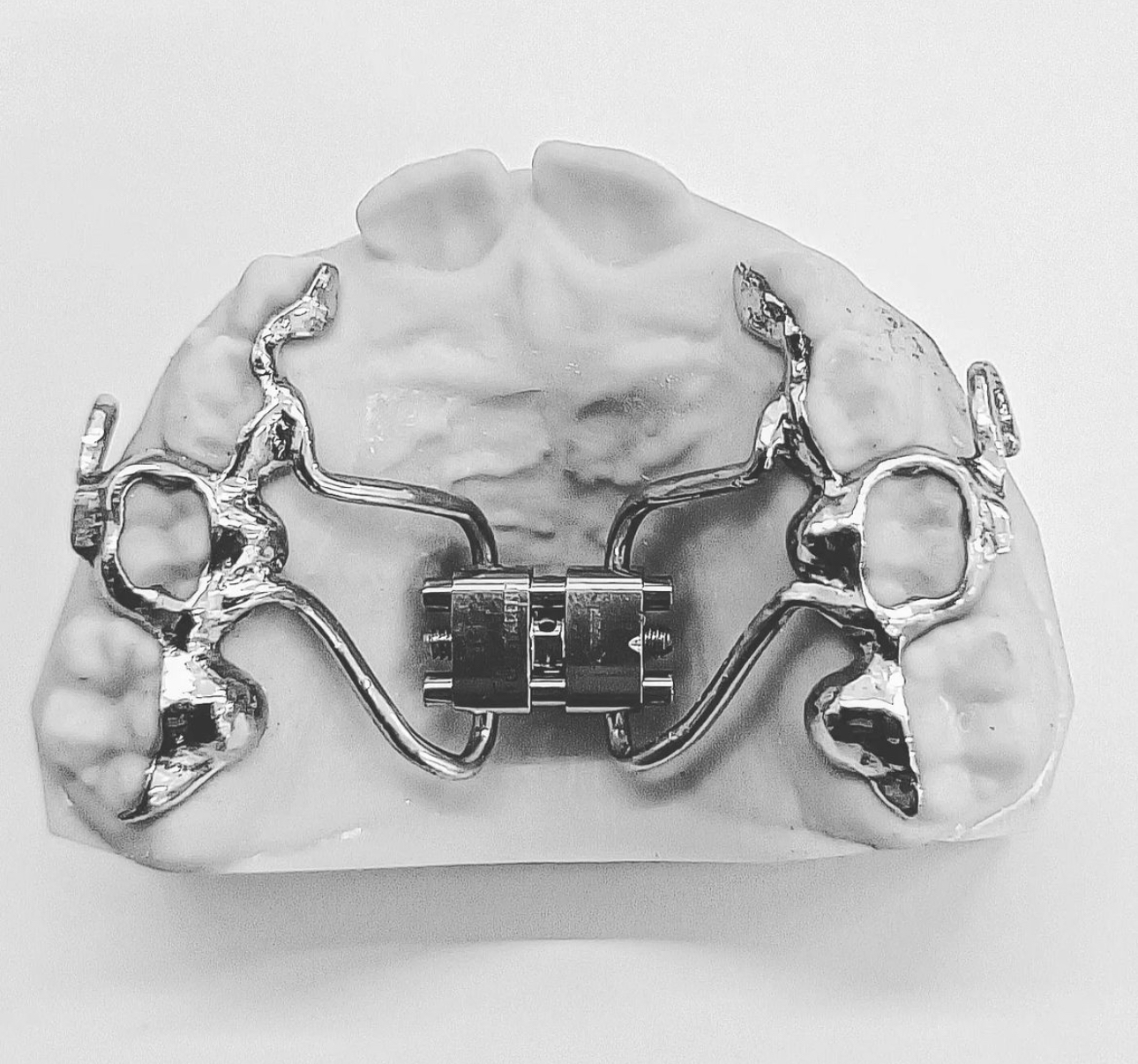
In younger children, the mid-palatal suture - the growth plate running down the centre of the upper jaw - is still soft and open. A Rapid Maxillary Expander (RME) is a fixed orthodontic device that anchors to the back teeth and gently widens this suture over several weeks.
Because the suture is naturally flexible at this age, expansion can be achieved comfortably and predictably with tooth-supported anchorage alone. No implants or bone anchors are required.
This is typically the preferred approach between the ages of 5 and 10, when growth guidance is most effective and least invasive.
Advantages
- • Non-surgical - no TADs or implants required
- • Highly effective during the growth window
- • Corrects crossbites and creates space for adult teeth
- • Can improve nasal breathing space width
- • Fixed in place — no compliance required
Considerations
- • Temporary gap between front teeth during expansion (closes naturally)
- • Speech adjustment for the first 1-2 weeks
- • Requires careful cleaning around the appliance
- • Less effective once the suture begins to fuse (typically from age 11-12)
Understanding Rapid Maxillary Expansion (RME)
Watch Dr. Steffen Decker explain what RME stands for, how it works, and how it may help support jaw development, space creation, breathing and facial growth in growing children.
View Video Transcript
How to Turn Your RME (Rapid Maxillary Expansion Device)
Watch Dr. Steffen Decker demonstrate how to safely and correctly activate your child’s expansion appliance at home. This short step-by-step guide explains how to insert the key, complete a turn correctly, and what to expect during treatment.
View Video Transcript
Important Note: Please only turn the appliance according to the instructions provided by your orthodontist. If you are unsure whether a turn has worked, or experience unusual pain, swelling, or difficulty activating the appliance, please contact the clinic.
How to Apply Your Delaire Face Mask (Reverse Headgear)
Watch Dr. Steffen Decker demonstrate how to correctly fit and position a Delaire Face Mask at home. This short step-by-step guide explains how the appliance works, how to attach it safely, and how it helps support forward growth of the upper jaw and facial development in growing children.
View Video Transcript
Important Note: Please only wear elastics and use the appliance according to the instructions provided by your orthodontist. If the appliance feels uncomfortable, does not fit correctly, or you are unsure whether it has been applied properly, please contact the clinic.
Tooth and bone-borne MARPE (e.g. MSE / FME)
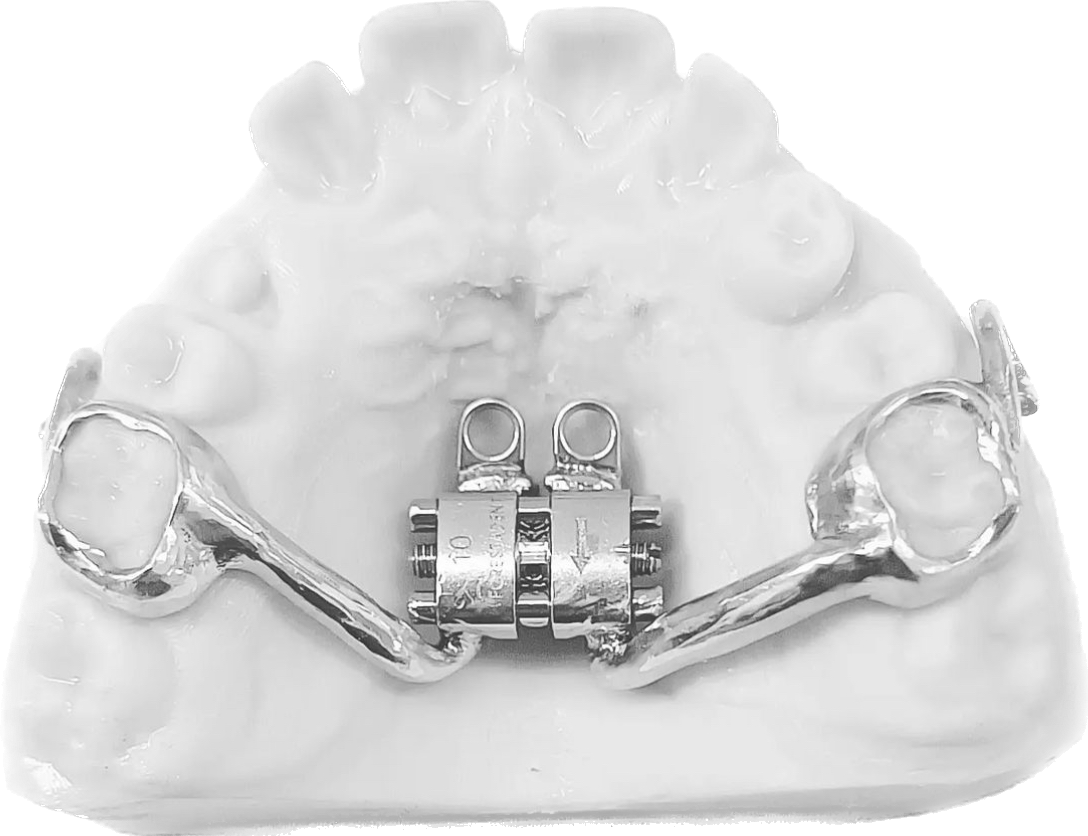
MARPE - 2 TADs
Simpler anatomy, symmetric suture
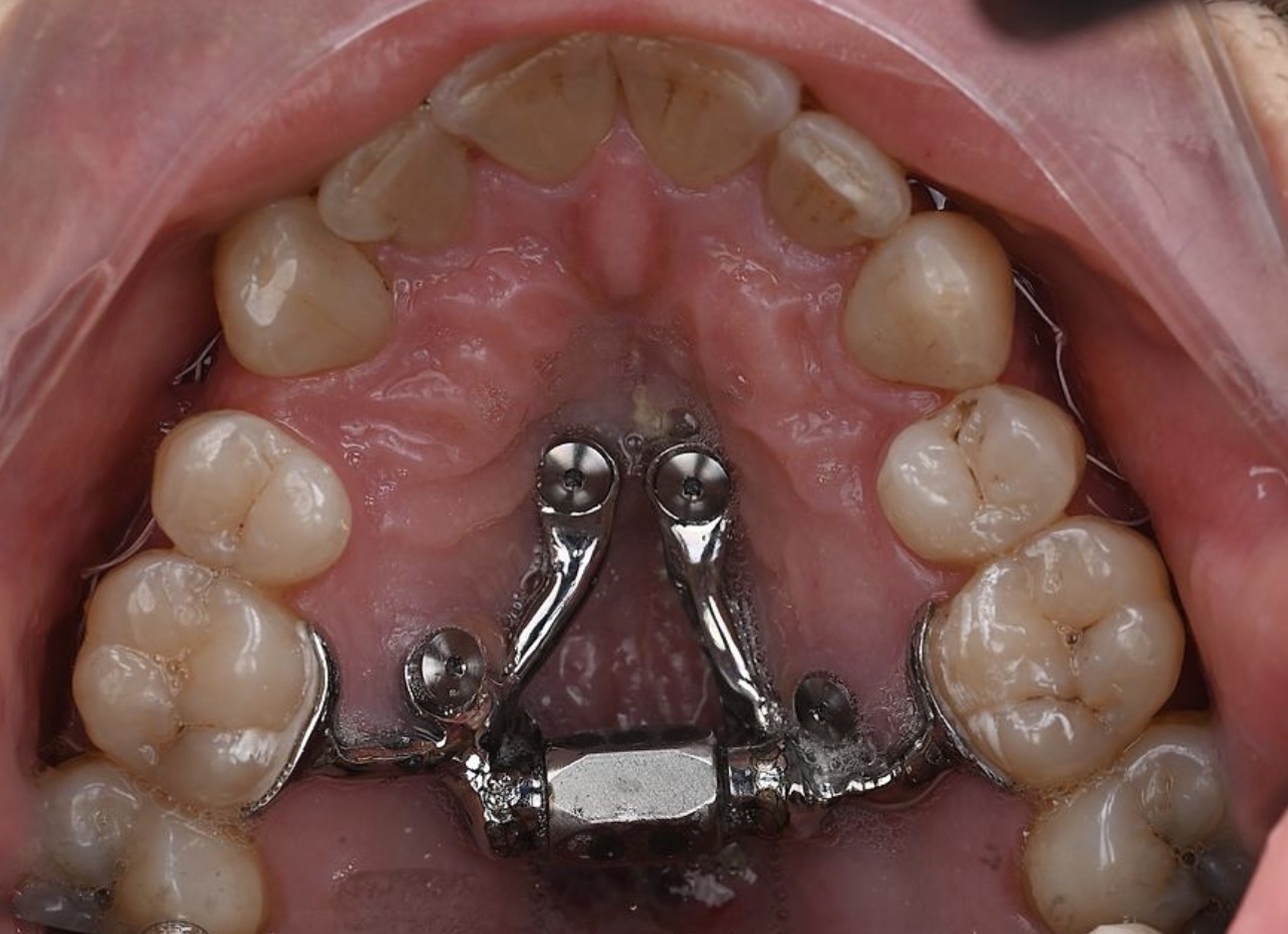
MARPE - 6 TADs
Greater bone anchorage, more complex cases
As children enter their teenage years, the mid-palatal suture begins to calcify and become more rigid. A conventional tooth-borne expander alone is no longer sufficient to open the suture predictably - this is where MARPE comes in.
MARPE (Miniscrew-Assisted Rapid Palatal Expansion) combines the expander appliance with small titanium mini-screws (TADs - Temporary Anchorage Devices) that are gently placed into the palatal bone. This allows force to be applied directly through the bone, opening the suture even as it matures.
We use advanced systems such as the MSE (Maxillary Skeletal Expander) and FME (Facegenics Midface Expander), which are planned with CBCT imaging for precision and safety.
How many TADs are used?
Depending on the system and individual anatomy, MARPE typically uses 2 to 6 mini-screws. These are placed under local anaesthetic, are very small, and are removed once expansion is complete.
Advantages
- • Opens the palatal suture even in older teenagers
- • Skeletal expansion - changes the bone, not just the teeth
- • Significantly improves nasal breathing space volume
- • Avoids orthognathic surgery in many cases
- • Can support improved breathing and sleep quality
- • Precise - planned with 3D CBCT imaging
Considerations
- • Requires placement of 2-6 mini-screws under local anaesthetic
- • Mild discomfort for 1-3 days after placement
- • Temporary gap between front teeth during expansion
- • Speech adjustment for the first 1-2 weeks
- • Higher cost than conventional RME
Understanding MARPE & Expansion
Thorough assessment is crucial to decide where and what to expand. Watch Dr. Millie explain how we use TADs and MARPE to improve airway function and support facial structure, along with what the procedure actually involves:
View Video Transcript
RME, MARPE, FME & SARPE Compared
The right expander depends on age, bone maturity and individual anatomy. This table gives a general overview — your own recommendation can only be made after a full assessment.
| Appliance | Who it suits | Typical age range | Surgery needed | Typical active treatment length | Learn more |
|---|---|---|---|---|---|
| RME | Younger children with an open, flexible suture | Roughly 5–10 years | No surgery — tooth-borne only | 2–4 weeks active, then several months retention | Palate expanders explained |
| MARPE | Older teenagers and adults with a maturing or fused suture | From around 11 years into adulthood | No jaw surgery — mini-screws under local anaesthetic | 2–4 weeks active, then several months retention | Adult palatal expansion (MARPE) |
| FME | Adults needing a patented, proprietary midface expander (Facegenics Midface Expander) | Adults (on request, subject to suitability) | No jaw surgery — mini-screw anchorage | 2–4 weeks active, then several months retention | MARPE vs FME explained |
| SARPE | Adults whose suture will not open with MARPE alone, or where surgery is clinically indicated | Adults | Yes — surgically assisted (jaw surgery under general anaesthetic) | 2–4 weeks active, then several months retention | MARPE vs SARPE explained |
Expansion for children from age 4
Early screening from age 4 is possible, provided the child is able to cooperate and we can take the full clinical records we need — including x-rays, photographs and intra-oral scans — so that an appliance can be manufactured safely and accurately. An early assessment does not mean your child will necessarily need treatment; in many cases the most appropriate recommendation is simply to monitor growth and review at the right interval.
When expansion is indicated during the growth window, a tooth-borne RME can gently widen the palate while the suture is still open, creating space, correcting crossbites and supporting nasal breathing — without extractions or surgery.
Expansion for teenagers
As children enter their teenage years the mid-palatal suture begins to calcify, so a conventional tooth-borne expander alone may no longer open the suture predictably. MARPE (using systems such as MSE and FME) combines the expander with small titanium mini-screws placed in the palatal bone, allowing force to be applied directly through the bone. This makes skeletal expansion possible for older teenagers who have outgrown a standard RME.
Timing treatment around the growth spurt gives us the best chance to guide jaw development, and expansion can be combined with braces or clear aligners as part of a single, coordinated plan.
Expansion for adults without surgery
Although the mid-palatal suture fuses in adulthood, MARPE, FME and MSE use miniscrew anchorage to apply expansion force directly through the bone. For many adults this means the suture can be opened in the clinic without the jaw surgery involved in SARPE. Suitability is always confirmed with CBCT imaging during your assessment, and not every adult is suitable — we will advise you honestly about your individual anatomy and options.
Adult expansion can be integrated with clear aligners or braces, and for some patients it forms part of a broader airway-focused or interdisciplinary plan with your dentist or ENT specialist.
Palate Expander FAQs
What is a palate expander?
A palate expander is a fixed orthodontic appliance that gently widens the upper jaw (maxilla). It works by opening the mid-palatal suture — the growth plate running down the centre of the upper jaw — to create more space for the teeth, improve the bite and widen the nasal airway. The type we recommend depends on your age, bone maturity and individual anatomy.
Does a palate expander hurt?
Placement of a tooth-borne RME is generally comfortable. When mini-screws are used (MARPE, FME, MSE), they are placed under local anaesthetic, so the procedure itself is not painful. During the active expansion phase you or your child may feel a sensation of pressure in the roof of the mouth, midface or nose, but severe pain is uncommon. Over-the-counter pain relief is usually sufficient for any mild discomfort.
How long is an expander worn?
The active expansion phase — when the jaw is actually widening — usually takes two to four weeks. The appliance then stays in place for several months (typically four to six) so new bone can form and consolidate in the opened suture. After this retention period, clear aligners or fixed braces are used to align the teeth. Your orthodontist will give you a timeline based on your individual assessment.
Can adults have a palate expander?
Yes. Although the mid-palatal suture fuses in adulthood, miniscrew-assisted expanders such as MARPE, FME and MSE can apply force directly through the bone, allowing many adults to be expanded without the jaw surgery involved in SARPE. Suitability depends on individual anatomy and is confirmed with CBCT imaging during your assessment. Not every adult is suitable, and we will advise you honestly.
What does a palate expander cost in the UK?
Fees vary depending on the type of expander, the complexity of your case and the clinician carrying out the treatment. We list our fees transparently on our pricing page, with finance options available. We do not quote a fixed figure here because the right appliance and plan can only be determined after a full assessment. Please see our fees page for current pricing.
Will expansion change my face?
Palatal expansion widens the upper jaw, which can subtly broaden the midface and the base of the nose. In growing children these changes are part of normal growth guidance. In adults the changes are usually modest. Expansion is not a cosmetic facial-contouring treatment, and we will explain the realistic, individual changes you can expect based on your records before you decide to proceed.
For current fees please see our pricing page.
Common Questions
Slow or rapid expansion – which does my child need?
It depends on your child's age, stage of growth and how much expansion is needed. This is decided at the orthodontic assessment, where we assess jaw width, growth and individual anatomy before recommending an approach.
My child breathes through their mouth or snores – should we be seen?
Yes. An orthodontic assessment checks jaw width, growth and airway-related signs. We see children from age 4, and where mouth breathing or snoring is present we may also recommend assessment by an ENT or sleep physician as part of a multidisciplinary approach.
What age should my child first see an orthodontist?
From age 4, provided the child can cooperate with records (x-rays, photos and intraoral scans) so an appliance can be made if needed. An early assessment does not mean your child will necessarily need treatment; in many cases the most appropriate recommendation is simply to monitor growth and review at the right interval.
How much does it cost?
Palatal expanders for children start from £3,250 and teen MARPE from £4,950. Please see our pricing page for current fees, as the exact cost depends on the type of expander, case complexity and the treating clinician.
At a Glance: RME vs MARPE
| Feature | Tooth-borne RME | MARPE (MSE / FME) |
|---|---|---|
| Ideal age | Under 11 years | 11-17 years |
| Anchorage | Teeth only | Teeth + bone (2-6 TADs) |
| Suture maturity | Open / flexible | Calcifying / fused |
| Mini-screws needed | No | Yes (2-6 TADs) |
| Nasal breathing benefit | Yes | Yes (often more significant) |
| Invasiveness | Non-surgical | Minor (local anaesthetic) |
| Planning | Clinical assessment | 3D CBCT imaging |
What Does the Research Say?
Evidence-Based Palatal Expansion
Clinical research strongly supports palatal expansion for correcting transverse maxillary deficiencies (narrow upper jaws) and crossbites. Studies show that early expansion (using RME before the mid-palatal suture fuses) achieves highly predictable skeletal change. In adults, research confirms that Miniscrew-Assisted Rapid Palatal Expansion (MARPE) successfully opens the fused suture, providing true skeletal expansion without orthognathic surgery.
Key Findings
- Expansion significantly increases nasal cavity volume.
- It reduces nasal airway resistance, supporting healthier breathing.
- Early RME prevents asymmetrical lower jaw growth caused by crossbites.
Clinical Relevance
- Timing is critical: RME is most effective between ages 6 and 10.
- In adults, CBCT imaging is mandatory to assess bone density before MARPE.
- Expansion creates space, often preventing the need for tooth extractions.
Is expansion right for your child?
Whether your child is 5 or 15, early assessment gives us the best chance to guide jaw growth at the right time. Book a growth assessment and we will advise on the most appropriate approach for their age and development.
Frequently Asked Questions
Does palatal expansion hurt?
The placement of MARPE is done under local anaesthetic, so it is relatively painless. During the active expansion phase, patients may feel a sensation of pressure in the roof of the mouth, midface, or nose, but severe pain is uncommon. Over-the-counter pain relief is usually sufficient for any mild discomfort.
Can adults really have palatal expansion without major surgery?
Yes. While the mid-palatal suture fuses in adulthood, advanced techniques like MARPE (Miniscrew-Assisted Rapid Palatal Expansion) use bone anchors to apply force directly to the bone, effectively opening the suture without the need for traditional multi-jaw orthognathic surgery (like SARPE or Le Fort I osteotomy) in many cases.
Will palatal expansion improve my breathing?
Because the roof of the mouth is also the floor of the nasal cavity, widening the maxilla simultaneously increases nasal cavity volume. Many patients report a significant reduction in nasal airway resistance and improved nasal breathing, making it a valuable tool in airway-focused orthodontics.
How long does the expansion process take?
The active "turning" phase where the jaw actually widens usually only takes 2 to 4 weeks. However, the expander must remain in place for 4 to 6 months to allow new bone to form and consolidate in the expanded suture space. After this, clear aligners or fixed braces are used to align the teeth.
Will I get a gap between my front teeth?
Yes, a diastema (gap) between the upper front teeth is a positive sign that the skeletal suture has successfully opened. This gap is temporary and will be closed during the subsequent orthodontic phase with braces or aligners.
What is the difference between RME and MARPE?
RME (Rapid Maxillary Expansion) is typically tooth-borne and used in children under 11 whose mid-palatal suture is still soft and open. MARPE (Miniscrew-Assisted Rapid Palatal Expansion) is used for older teenagers and adults; it uses temporary bone anchors (miniscrews) to apply force directly to the calcifying bone, rather than relying solely on the teeth.
Why Trust The Orthodontic Specialist?
Led by Dr Steffen Decker (GDC 131767), our team specializes in evidence-based palatal expansion for all ages. We utilize state-of-the-art 3D CBCT diagnostics and custom-designed MARPE appliances to ensure safe, predictable skeletal outcomes. Our clinicians teach these advanced techniques globally through the GrowIQ Dental Academy and collaborate closely with ENT specialists and myofunctional therapists to support your lifelong airway health.
Treatments
Palatal expansion (MARPE)Clear aligners in Amersham (Smartee)Fixed bracesLingual bracesExpandersFeesPatients
Children's orthodontist in AmershamTeenage orthodontics in AmershamAdult orthodontics in Amersham and LondonTrading Statement
Deckerhie Limited (trading as The Orthodontic Specialist) (FCA FRN: 933774) is an Introducer Appointed Representative of Simplyhealth Funding Services Limited.
Deckerhie Limited introduces customers to credit provided by third-party lenders via Denplan Limited, which acts as a credit broker and facilitates introductions to the lender. We do not provide credit or offer financial advice and act only as an introducer.
Deckerhie Limited may introduce customers to more than one finance provider and may act as an Introducer Appointed Representative for more than one principal firm. The relevant principal firm will be identified to you before you enter into any agreement.
Simplyhealth Funding Services Limited is incorporated in England and Wales, company no. 03681199. Registered office: Anton House, Chantry Street, Andover, Hampshire, SP10 1DE. Simplyhealth Funding Services Limited is authorised and regulated by the Financial Conduct Authority, Financial Services Register number 308943 to carry on regulated consumer credit activities.
Denplan is a trading name of Denplan Limited. Denplan Limited is incorporated in England and Wales, company no. 01981238. Registered office: Anton House, Chantry Street, Andover, Hampshire SP10 1DE.
Zopa Bank Limited (10627575) is incorporated in England & Wales and has its registered office at: 1st Floor, Cottons Centre, Tooley Street, London, SE1 2QG. VAT Number 281765280. DivideBuy's trading address is First Floor, Brunswick Court, Brunswick Street, Newcastle-under-Lyme, ST5 1HH. © Zopa Bank Limited 2024. All rights reserved.
Denplan Limited is an Appointed Representative of Simplyhealth Funding Services Limited. Financial Services Register number 195821. Denplan Limited is a credit broker and not a lender in respect of regulated credit agreements.
Credit is arranged by Zopa Bank Limited trading as DivideBuy. Zopa Bank Limited trading as DivideBuy is authorised by the Prudential Regulation Authority and regulated by the Financial Conduct Authority and the Prudential Regulation Authority, and entered on the Financial Services Register 800542. Simplyhealth Funding Services Limited acts as a credit broker, not a lender, and introduces patients to Zopa Bank Limited (company no. 10627575).
Credit is subject to status and affordability. Applicants must be aged 18 or over and resident in the UK. Missing payments may affect your ability to obtain credit in future. Please spend responsibly.
Simplyhealth Funding Services Limited receives a commission from Zopa Bank Limited for these introductions. The commission may vary depending on the product and amount borrowed. This does not affect the amount payable by the customer or the interest rate offered.